
Timelines to what? A proposal
Why you might want to DIAL in to short timelines

People in the AI field love to talk about “timelines.” Sophisticated people in the AI field love to ask: “timelines to what?” Automation of AI R&D? (By which metric?) AI that far surpasses humans at nearly all cognitive tasks, or “TEDAI”? Artificial general intelligence? Something more ambitious?
Those answers are each about what AI can do. In this post, I argue that in timelines discussions, we should ask not what AI can do, but what we can do to shape AI outcomes.
More precisely:
The default answer to “timelines to what?” should be “when the most important decisions will get made”1;
We should think of those decisions as having a distribution, not a deadline;
Your own decisions related to that distribution need to account for how your leverage varies in different timelines.
In other words, the key timeline is the DIAL (Decision Importance, Adjusted for Leverage) Distribution.
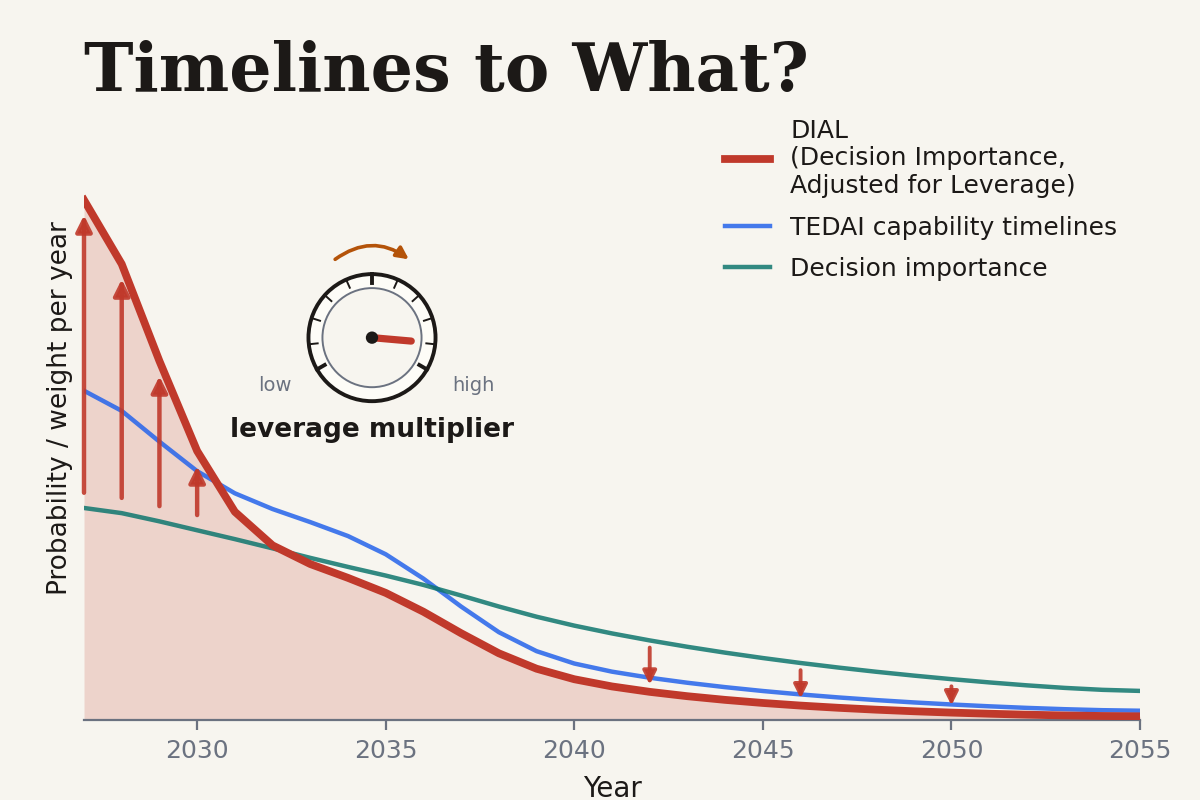
The distribution of decision importance
Let’s say you’re considering the social impact implications of a career decision, e.g. whether to get a master’s in public policy, and you want to factor in AI timelines. To dramatically oversimplify for the sake of illustration, let’s say:
You’d enroll from January 2027 to December 2028.
You’ll be 40% more impactful per year after getting the degree, relative to if you jumped straight into an entry-level policy job.
The degree’s effects go to zero after 2036 (when the rest of your resume will matter more anyway).
Your impact doesn’t change over time during this period.
How should you weigh the potential effects of TAI timelines?
It might be tempting to pick a “median transformative AI (TAI)” timeline estimate – let’s say the end of 2033 – and say: if I start in January 2027, I’ll have a 7-year career before TAI (and then who knows what happens); if I start in January 2029, I’ll have a 5-year career; the 40% boost makes this a perfect tie on impact grounds.
But, as Toby Ord observes, someone in this position should think of timelines in terms of a distribution, not a point estimate, of when “transformative AI” will be developed. So maybe you should instead do a calculation like this (using four-year buckets that roughly correspond to presidential administrations, since that’s often a natural calendar for policy careers):
Now, the degree barely wins.
I think this is a big improvement over the simpler math with a median. But I think a further improvement would be using a distribution of decision importance.
Sometimes, one’s “timelines” are treated as a kind of deadline: “Nice plan you’ve got there, but we’ll probably have TAI before that point.” But the decisions that matter most for AI’s impact on the future seem likely to take place in the years before and after some of these key milestones. Probably, some have already happened. Some will get made shortly before or after the development of an AI that poses significant risk of human extinction via the AIs dominating humans and insufficiently caring about our survival, or via wonder weapons, and thus potentially have a large effect on the likelihood of those risks. If we do avoid those risks, humans will also make some of our most important decisions about how to use AI’s capabilities to improve, secure, and/or expand our civilization.
To put my rough numbers on it: if you defer to Ryan Greenblatt on AI capability timelines (as I basically do), you might get something like a 25% chance of full automation of AI R&D by September 2028 and a 50% chance by March 2031. But Greenblatt’s “decision importance” timelines are noticeably later than these; in a recent conversation, he endorsed something like 15% of decision importance before 2029, 25% in 2029–2032, and 20% in 2033–2036, leaving 40% for after 2036.
Now, the master’s wins more decisively, because even though work in 2027-2028 is strictly less likely to be obviated by the arrival of TAI, the following years are actually more important.
Leverage changes the math dramatically
But decision importance alone isn’t enough. You also have to ask: in which timelines does your work matter the most?
I’ll cite Greenblatt once again for several arguments for boosting impact estimates in short timelines, condensing his points into two:
Neglectedness. Longer timelines means many more people, including e.g. world leaders, will probably start to focus on the problem, and existing lines of effort will have more time to pay off; the situation will get less “on fire” over time as we find and implement governance and technical solutions.
Tractability. If timelines are soon, we can target efforts more precisely; we probably know the countries and companies most likely to develop powerful AI, the general techniques used to develop it, and the political leaders and dynamics governing its development. It may also be easier and more productive to work on these risks when they’re more immediate and concrete.
So, even if you’d be 40% more impactful in any given year with a master’s than without, your labor could reduce the risks more in absolute terms if you focus on shorter timelines.
For the purposes of this exercise, I’ll use a 3x multiplier for pre-2029 worlds, relative to 2029-2036, and a 1/3x multiplier for post-2036 worlds. Quite possibly these are totally wrong; these numbers come from crudely repurposing the median answers to a slightly different question in an internal survey CG conducted in 2024. But I think the arguments for these ratios being higher seem comparably good to the arguments for them being lower.
If you take Greenblatt’s decision importance distribution, weight it by these leverage estimates, and normalize back to 100%, you get a Decision Importance Adjusted for Leverage (DIAL) Distribution of about 44% on pre-2029, 24% 2029-2032, 19% 2033-2036, and 13% post-2036:
Now, the master’s no longer pencils: even though you would get a boost in post-2028 timelines, the rest of the world effectively also gets a boost, and you’d miss the most “on-fire” time. It’s better to show up to the fire immediately with a less powerful hose.2
I’m not saying no one should get a master’s (though, I should note, I probably won’t return to mine after my current 4-year leave of absence) or otherwise invest in longer-timelines strategies. In fact, I’m not sure the AI safety field’s distribution is especially far off from the allocation implied by these leverage-weighted numbers. But this definitely seems worth including in your model.
I vaguely remember Will MacAskill suggesting we think of timelines to “the crucial year,” which is a similar point, but I think the important decisions could span significantly more or less than a year.
Note that the master’s is actually a relatively flexible type of investment in medium-to-long timelines: it suffers from the “neglectedness” point, but the master’s is then pretty beneficial if the pre-2029 timelines don’t happen. By contrast, doing research aimed at longer timelines gets hit by both the neglectedness point and the tractability point: the research has to speculate about a TAI development situation that might be quite different from the present.
Thanks for this! I'm a recent college grad with a master's in hand -- so the decision of looking to contribute in (relatively) shorter timelines vs longer timelines is something I think about a lot. I found the specific numbers (and overall modelling approach) in leverage for shorter vs longer timelines to be very clarifying.